

When I heard of Steve Jobs’ death last night, my first reaction was a simple “wow”. You know, the kind you get when you knew something of significance just happened. While I never had the opportunity of meeting Steve Jobs personally, I felt that I somehow knew him. He was an unknowing role model for me as he was for so many I suspect. A model of the power of entrepreneurial spirit, of one’s tenacity, vision and elegance and how one person can change the world. As Steve himself once said:
“I’m convinced that about half of what separates the successful entrepreneurs from the non-successful ones is pure perseverance.”
It wasn’t always easy either. Take for instance, his fall from grace in 1985 when he was ousted from Apple by his own board and Microsoft ascended to the world stage. The Mac became relegated as just a niche product, although much loved by graphic designers and musicians — but not for serious business work. Oh, and do you remember the Lisa Computer and Newton Tablet? But all of this helped shape him too. Failure is a strong teacher.
He went on to acquire Pixar in 1986, you know the “Toy Story” and “Cars” movie production company. And he also founded NeXT in 1988, a very sophisticated workstation company, that ironically brought him back into the Apple fold when they bought it in 1990.
He wasn’t just a magician on the stage of a new product launch or a designer of aesthetically pleasing yet elegantly simple products either. He was much more than that. He knew that great design was not just what a product may look like, it was how it worked as well. On the iPad, he said “it’s technology married with liberal arts, married with humanities and yields the results that make our hearts sing.” And sing they have. He knew that you “can’t just ask customers what they want and then try to give that to them. By the time you get it built, they’ll want something new”.
He also had a the ability to say “no”. One of the hardest things that a leader needs to do is to decide which product or service to nurture and which to kill. He had an uncanny ability to see what the future might be and to separate the wheat from the chaff.
At one minute assailed as a bit of a hippy forever railing against big companies and then hailed by many of the same as one of the greatest CEO’s of our time — if not of all time. He was a lesson in contrasts.
One of his most powerful gifts however was the almost fanatical loyalty of his customers. It was thru them that he created the most respected technology company and later revered CEO in the world. I remember in the mid-80’s when Apple came out with their first Macintosh. We had just opened up our first personal computer store in West Michigan and Apple was just emerging as a real alternative to the Microsoft PC. To introduce their radically different personal computer (it had a graphical user interface and a single-click mouse) they rolled out a “drive-a-Mac” program to let prospective clients take it home to try it out.
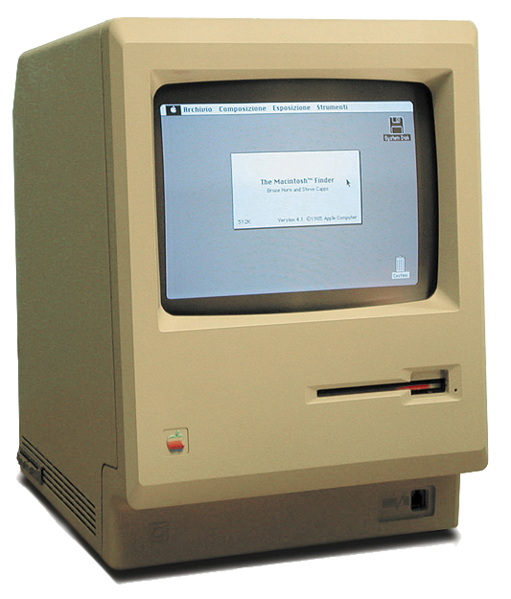
At its introduction, I had our 3-year old daughter demonstrate its drawing program; cajoling our visitors that if a 3-year could use it so could they (and I still have that original computer in its original carrying case safely stored in my basement). That 3-year old is now a Doctor in her early 30’s — and is still a loyal Apple customer.
He was also an inspiration through his words. Here we have him at the 2005 Stanford University Commencement Address:
“Your time is limited, so don’t waste it living someone else’s life. Don’t be trapped by dogma – which is living with the results of other people’s thinking. Don’t let the noise of other’s opinions drown out your own inner voice. And most important, have the courage to follow your heart and intuition. They somehow already know what you truly want to become. Everything else is secondary.”
Steve Jobs’ 2005 Stanford University Commencement Address
You will hear and see much of Steve Jobs’ life and accomplishments in these next few weeks. I think that the following commercial that he narrated but never aired (the Richard Dreyfuss version did) can tell a little of his entrepreneurial spirit that helped define who he was.
The first Think Different commercial
“Here’s to the Crazy Ones”.
We will miss but not forget the legacy and vision that Steve left for us all. So… here is to the young man who once said the he wanted to “put a ding in the universe” — and he did. And here is to one less crazy one with hopes that you too will be a little crazy. Thank you Steve Jobs.

 Musings at Altitude
Craig, a well written synopsis of what made Steve so special. I particularly liked your points of saying NO and not asking the customer what he wants because by the time that you get it to him, he wants something else. Arlyn