 “We’ve always done it that way”. Not a good answer for sure. Perhaps it is better for them if they are the one responsible for the results in case something else happens. It seems that everybody wants change but nobody wants to change. Change can be risky after all.
Having said that, if you are not making mistakes, you are probably not making decisions either. For, if we are living today, we are in living an environment of constant change. There is no doubt, that the rate of that change is ever increasing. Nowhere is that more visible than in the startup world.
You cannot be complacent in the “corporate world” either. As I like to say, “while there is a cost of doing something, what is the cost of not doing it?” For some, it is irrelevance.
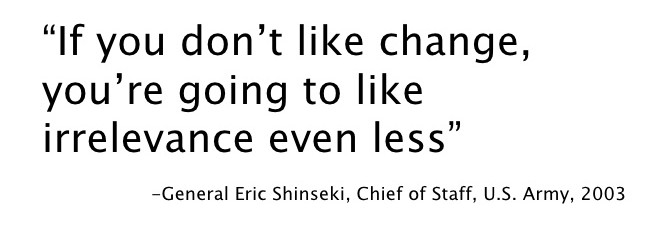
I have always loved to compete with organizations that seemed to be so “hide bound” and risk adverse that they never seemed to make a decision. There never seemed to be enough data for them to decide. Letting the “other guy” go first was easier. So the result of the three deadly “C’s’ to Innovation becomes: Comfort, Contentment and Complacency. Great things never come from your comfort zone.

This is the defensive game of “not losing”. But time waits for no one and neither may that opportunity. Therein lies the opportunity for the startup or organization with the innovative culture to help make that incumbent irrelevant. This is the game of “winning”. My experience has shown me that this happens most frequently with a change in leadership, but it can also come ironically with great success.
If you are competing against an organization that is trying to “not lose”, maybe you can help them be their change agent by making them irrelevant. Disruption tends to do that, you know. Furthermore, if you are in an organization where that game has changed “from winning to not loosing”, maybe it is time for you to move on before they too be come history.
In the end, it seems that the largest impediment to change is History itself. Don’t let the cost of “doing it” overwhelm your future. For the cost of “not doing it”, might be your own relevancy.

 Musings at Altitude